Thursday, February 22, 2007

Plettenberg Bay

One of the best known and well-loved parts of South Africa is the Garden Route which stretches for quite some distance along the southern coast. We're part way along it but have been very impressed so far with the winding roads, water features and lush vegetation. Unfortunately, we won't be able to do it any justice by travelling on a backpackers' bus - best done in a car where you can stop and look whenever you wish.


Plettenberg Bay is one of the most popular stops along the Garden Route. It's a huge tourist destination for the South Africans themselves. There are actually few high quality beach spots along the southern coast - much of it is rocky headland and the waters are very unsafe due to strong currents, sharks, etc. I read that 40 00 of the well-to-do from Johannesburg alone come here to vacation at Christmas time!

Plettenberg Bay stretches along a couple of beaches separated by a small finger-like peninsula.

The first view I have shown is of Robberg Beach with Robberg Nature Reserve in the distant background. The view below (after the peninsula) is called Keurboom's Beach.


Keurboom's Beach is incredibly shallow and extensive during low tide but as is the case with all such beaches...watch out when the tide is on its way in!

The pictures speak better than the words...

That's all I have to say from here. We've had a couple of days of chilling out. I think that Nancy is a little tired of my saying "this is as good as it gets" each morning when we begin our walk but apart from that we're great!

Later today we're off to a place called Nature's Valley. Tomorrow we'll begin the Otter Trail which is one of the premier walking trails in the country. It'll be a tough slog but we're feeling up to it. Since we're going bush we won't be blogging for a week or more. Think of us as we think of you!

Monday, February 19, 2007

Oudtstoorn

Greetings from Oudtshoorn (pronounced "out sworn"as in having lost a profanity contest- great place for a couple of teachers trying to get away from it all, don't you think?). Travelling east from Swellendam a few days ago we rounded Mossel Bay: a popular, glittering body of water. From there we passed through the city of George then north to this sedate town which is the unofficial capital of the Little Karoo. There's also a Great Karoo - both of them very arid and hot places. The "Little" and "Great" refer to the degree of water deprivation each area suffers through. It is usually 38-40 degrees here at this time of the year! The Great Karoo is like the interior of Australian - a harsh inland desert that was once nevertheless a tropical sea basin.

Well, it didn't take long for us to figure out that in Oudtshoorn, it's all about the ostriches! The surrounding farmlands are thick with these birds which have been bred here since the late 1800s. The warm climate and loamy soils of the Oudtshoorn Valley constitute ideal growing conditions for "lucerne" - the favourite feast of our fast, feathery, flightless friends! In total, there are some 300 ostrich farms in the region. The birds live for 40-50 years.


When in Rome (or in this case, Oudtshoorn), . . .
Our first morning here we joined some other guests of "Backpacker's Paradise" for a traditional ostrich egg breakfast. It was quite good - a chewie texture than that of a hen's egg and much "yolkier" in flavour. After breakfast we set off to explore the town. Rick sure was moving faster than normal! I had a hard time just trying to catch up!!!


The male ostrich is black and white with some golden brown on its wings; the female is brown and white. The juvenile is a light brown and white, the gendre indistinguishable for the first few years. Although the image below may make it appear that an ostrich is glamorous (check out the lovely eyelashes) and suave, all that glitters is not gold. Each of an ostrich's eyeballs weights about 60 grams; the mass of the brain is 40 grams. By the way, it is actually a myth that these odd-looking birds bury their head in the sand.


After a visit to the very informative C.P. Nel museum, we feel like we could challenge even Jeopardy champion, Ken Jennings, if the category was "The Ostrich"! Here are some tidbits of what we learned for you trivia buffs out there. The barbules on the feathers of an ostrich are not interlocking which render the bird useless for flying. One ostrich egg measures 150 x 120 mm in size. In fact, it is the equivalent of 25 chicken eggs! Although its shell is only 2mm thick, it can withstand a weight of up to 220kg!!! The reason that the eggs are so strong is because they have to support the weight of either the male or female on the nest - female ostriches have been emancipated. To make the eggs resilient the female needs a lot of minerals (especially calcium) so it often ingests rocks and pebbles. When they empty the contents of a stomach they often find sticks and other hard objects too. If the bird can't find enough rocks it will consume just about anything hard - including spark plugs or sunglasses! That's a lot of fibre so an ostrich has an extra appendix. When a female lays its first egg of the season it immediately eats it. If its not high enough in calcium then it will temporarily cease to produce more eggs.


FORTUNES were made from the fashion for ostrich feathers! In the 1880s, hundreds of thousands of kilograms of feathers were being exported! At that time, feathers constituted 40% of all agricultural products in the country! A day old ostrich chick would trade for 60 bags of corn or 1080 litres of brandy! At the time the feathers were considered to be more valuable than gold. The reason was that they were prized throughout the fashion houses of Europe.


The feathers also became an important component of ceremonial and sometimes even military dress in Belgium and beyond. Actually, generals dating back to the Roman Empire often wore military hats adorned with ostrich feathers.


Oudtshoorn grew rich and the feather barons built grand houses that have been well preserved and lend the town its charm still today. Feather auctions were held in Oudtshoorn every 14 days and the wealth of the ostrich industry drew many immigrants. The "new" concept of automobile travel in open "tourers" in the 1900s soon out-moded large feather bedecked hats. The outbreak of war also forced the need for "practicality" in fashion causing feather sales to plummet. Today ostrich meat and skins produce a tidy profit.


We had seen the ostrich palace pictured above from a distance as we walked along the main street (called Baron von Feather Meister or something like that) during our first morning in the city. Upon investigation we discovered that it was converted into a high school below which a terrific track was built. What timing - the local elementary track and field championships happened to be taking place. Let me tell you, track and field is alive and well in South Africa! There was a full agenda of events, including the 100 metre and 200 metre hurdles for kids from about grade 5. The event was very well-organized and privately sponsored. There was also a large media contingent that had to have field level passes to gain entry and there were full-time announcers!

We enjoyed talking to some of the kids and watching them for the day. Perhaps most interesting of all was the fact that (as you see) almost nobody wore shoes for any event, track or field. It was blazing hot on the track, but I suppose they get used to it. We couldn't help but wonder about the liability issues as the kids spent the day, on the field and in the stands, in bare feet. Later in the afternoon there was an elite schedule of university events. Although most of the sprinters wore shoes, only one competitor in the 3000 metres women's steeplechase did.


Prior to the university meet there was an "opening ceremony" which featured fifteen minutes of singing and dancing. The crowd was very enthusiastic throughout the entire event - it was fun to be there! At the end of it all there was an open 200 meter race for anyone over eighteen who was willing to paint their hair yellow (or wear a yellow wig) since the event was sponsored by the Yellow Pages. The prize was 1000 rand, no small sum. Would have loved to participate but was still a bit sore from a climb and didn't want to risk injury prior to the Otter trail.


Riding an ostrich for about thirty seconds was exciting and great fun. I know you're probably thinking, poor animals and all. I admit, the animal rights activists would certainly have me over a barrel on this one. I was hesitant to get on until I watched somebody else (much bigger than me) try it out so that I could see how the animal responded. Now it's not a very easy thing to know what an ostrich enjoys or is thinking but apart from balking when a bag was put over its head while I mounted, the bird didn't look to be stressed. There's virtually no meat on an ostrich breast - it's all packed into the legs, which are very strong. An ostrich can run at 70 km/hr for three kilometres. When they butcher a bird they get 30-40 kg of meat off of its thighs - that's a lot of drumstick!
As you can see the hired hands actually race the birds, so it's all part of a day-in-the-life of a farm ostrich, a routine that they have no doubt come to accept as their lot in life.

One of the main attractions around Oudtshoorn is the Cango Caves, which rank as one of South Africa's top ten tourist attractions. There were two tour options - a six gallery walk or the "adventure tour" which included the first two galleries then some splunking through some fairly challenging tight spots that went 1200 metres into the cave system. This we took; it lasted for a full two hours and was loads of fun! The caves were amazing!


Before we left Canada I promised Nancy's mother that I would try my best to take care of her daughter but its sometimes just plain difficult to keep an eye on the woman!


Guess that's it for now. I will leave you of a photo that we took on our way up to the Swartberg Pass - never quite got there (ran out of daylight) but maybe another time! A lot of the landscape photos look much better when enlarged. Thanks for the time taken to read such a long blog - hope you found it interesting. Thanks to those who have sent us e-mail messages to let us know that they're well and tuned in.


Saturday, February 17, 2007

Swellandam

Travelling eastward from Stellenbosch one soon comes to wide open stretches of land that support prosperous grain fields. They look very dry and barren at this time of the year because the harvest is largely over and summer is drawing to a close. In the distant north there is always the outline of tall and rugged mountains that mark the beginning of the Karoo, which is not unlike the Australian outback.


Before too many hours have passed one reaches the tranquil town (14 000) of Swellandam, South Africa's third oldest settlement. Stellenbosch had seemed very tame and safe compared to Cape Town; Swellandam is so low key that some of the people don't even lock their doors at night. It was nice to see fewer bars on windows, and less razor wire on fences. To be fair it should be mentioned that the bars are in some areas required to keep out the baboons. Swellendam is set below a small mountain range. Being a traditional Africaaner town, it has many of the Cape Dutch homes that have now become so familiar to us. Swellendam boasts a very fine Dutch Reform church. The streets are extraordinarily wide for such a small centre.


The people that we met at the hostel were a very interesting bunch. About half of them were of various ages from diverse places including a young Israeli couple on their honeymoon and a pair of retired teachers from Paris, France. The owner of the hostel spends most of her time running a horse ranch; many of the guests at the hostel were ferriers and other people who travel from town to town servicing that line of work. Most had thick rural accents which were sometimes hard for us to understand.

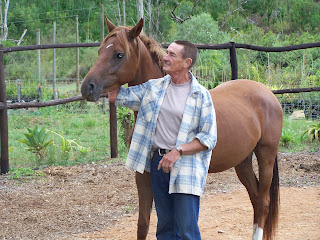
After four days we got to know well the main hired hand, Peter, a trainer of some ability who we came to think of as the horse whisperer. He was one of several refugees that we have met from Rhodesia\Zimbabwe that have fled the Mugabe government. A rather sad and lonely man, he often sought our company and talked openly about topics such as having fought in the Rhodesian civil war from 1965-1979, losing the family farm due to land reform policy, the death of his wife, and his two sons who live in New Zealand. He's survived a rather harsh life with "only a few holes" in him (both literal and figurative) but has learned to take life as it comes. Like many Africans, he accepts the "new South Africa" as part of an inevitable evolutionary progress. Peter shared with us how much he enjoyed a couple of brief visits to Canada, especially falling in love with the Edmonton Oilers during the Wayne Gretzky era.

One of the reasons that we stopped at Swellendam was to do some hiking, an appointment with the highly rigorous five-day Otter Trail (never too far from our minds). We're both getting quite dark and adjusting to the heat to the point that we can walk for several hours without too much discomfort. Our first day we headed to Bontebok National Park, six kilometres from the town.

The main attraction was to view the Bontebok antelope, one of the most lovely creatures you'll ever see, that was rescued from the brink of extinction once its numbers had dwindled to less than twenty-five. The animals were easy to see since the park is the smallest in South Africa at just 25 square kilometers. Still, they were quite jittery and moved off until we got down to a picnic area near a river. There we were able to see their immensely beautiful colouring (even in the ears!) up close.


The park is rather bare and dry...meaning snakes abound. The puff adder (a rather lazy serpent that insists that you walk around it ) and the cape cobra are forces to be reckoned with but we didn't have the pleasure of making their acquaintance. We'll get lots of other opportunities though. Did see lots of interesting birds. Hiked along the river for a ways and were in awe of the aloe plants that grow there. Some of them were grouped together in mini-forests that were 8-10 feet high! The one shown in the picture below is a mere infant, but very succulent!

A second and completely different hiking opportunity presented itself nearly on the doorstep of the hostel: the Marloth Nature Reserve. It supposedly still has leopards but it would be miraculous to see one during the day. The flora at the top of the mountain was fabulous. Never knew that red-hot pokers could climb that high. The photos below are of king protea, the national flower, and strawberry everlasting, a kind of fynbos (the main native species) of which protea is a sub-species. We were very interested in these. They look very much like raspberries until the flowers blossom.


We really enjoyed our time in Swellandan, staying in a little cabin off the garden of the hostel. Being in a smaller town makes you feel so much more grounded and able to connect with the locals. Made us think of home. One of the joys of having time to think is reflecting on the people in your life who mean so much. We think of our families and friends daily and trust that you are well.

Friday, February 16, 2007

The Power of the Grape

Greetings! I've updated the Cape Town page with a few new photos: some of the entertainers, hand-painted ostrich eggs from Greenmarket Square, a beautiful view of Cape Town taken from Robben Island (notice partial remains of a Portugese shipwreck in the foreground). We were sorry to leave the city - really needed two or three more days to see and do all we wanted to!

One of the interesting things about the history of Cape Town is that it was the only European settlement on foreign soil that was never intended to be a colony. In about 1652 The Dutch East India Company put a few ships ashore to organize a settlement. Its sole purpose was to grow fruits and vegetables to re-supply Dutch ships rounding the Cape of Good Hope on their way to the lucrative spice and silk trade in Java, India, and elsewhere in the Orient. There were strict rules preventing employees of the company from individual travel or enterprise. In a sense, the East India Company farmers were slaves before the Malaysian muslims and black men arrived in chains.

The human spirit being what it is, sooner or later a few noble souls took the risk and set off on their own. A few days' travel north-east of Cape Town, a man named Stel came upon a beautiful and fertile valley at the base of a mountain. Having endured a long and hot journey he began to think about what a grand thing it would be to have something pleasant to drink. Apparently, wine was the first thing to come to mind. Unfortunately, neither he or others who subsequently arrived at Stel's bush ("Stellenbosch") knew how to make the stuff. Fortunately for them , the Reformation in Europe had led to a Catholic backlash in some countries; many of the Hugenots (French Protestants) were fleeing in the face of persecution. It so happened that the Hugenots knew a thing or two about grapes. It was a perfect marriage - the beginning of the South African wine industry which is today one of the world's best. A decent bottle here sells for about $4-5!


Like everyone else who visits Stellenbosch, we enlisted for a winery tour. We had the chance to visit four different estates: two near Stellenbosch and the others in the other celebrated wine producing towns of Francishoek and Paarl. We learned a lot of interesting facts about producing and tasting wine and also had the chance to sample quite a bit of cheese. Each winery provides samples of five or six wines. We each chose our own samples and then shared and discussed each one as it was consumed. That means that after just the first two tours there were fifteen different wines sloshing around in our stomachs. Not being much of a drinker these days, I had to "call uncle" at that point and played more of an observational role until near the end of the tour. Nancy hung in there a little longer than I did but she too was looking a little green around the gills. Still, it was a very enjoyable day!


The second estate that we visited, Fairview, was the most interesting. It had beautiful grounds that included a pomegranate tree, which neither of us had previously seen. The winery is also famous for its spin-offs on famous French wines (e.g. Goats-d0-Roam, Bored Doe, Goat Door). In fact, the French government attempted to sue the winery over the use of the names. Don't know how that turned out... oh, Nancy says they were unsuccessful. Anyway, there are a couple of goats which live in a tower on the property. They're sort of the poster children for the winery and are used for making cheese which the winery also sells.


Most of the people that we met in Stellenbosch just breezed into the town for the wine tour and then left. We stayed on for an extra few days. Let's see if you can guess why.
A) We were really enjoying meeting people from around the world at the hostel.
B) We had found an awesome restaurant with excellent food at unbeatable prices.
C) Stellenbosch is an historic city with a walking tour of 52 impressive buildings.
D) All of the above.

The University of Stellenbosch is a very old and prestigious institution. Many of the country's greatest minds (and not so great, including the "brains" behind apartheid) studied in its hallowed halls of learning. The buildings are low-rise and the city has the feel of a busy country town. Tall oak, plane and gum trees line the boulevards of the campus. None are indigenous; people like Cecil Rhodes imported everything they liked in Europe, America or Australia when they migrated to South Africa, with mixed success. Since the oak trees are not native to this environment they are quite porous. Many a good barrel of wine ended up on the sidewalk until they realized that their oak was not good enough!
We have found most of the Africaaners of all ages to be helpful and very polite. It was fun to see many students hurrying off to class on Friday. Early on Sunday morning the church bells began to ring. Religion here seems to be B.Y.O.B. - bring your own bible. There was a steady stream of young couples coming from every direction, hand in hand, the good book tucked under their arms, on their way to church. Now that's not something that you see in Canada!
The buildings of the university as well as most of the homes and institutions of the time were constructed in what is known as the Cape Dutch style. The homes were built in the shape of a T and were almost always thatched and gabled. All of the structures were painted in lime to produce a very bright white effect - impressive against the normally bright blue sky of South Africa. High quality wooden shutters and split-level (barn-like) doors add to the appeal.
That's it for now. Stay well!


Sunday, February 11, 2007

Cape Town Collage

Howzit? (Afrikaans for How are you doing?) We hope you are all well and surviving what sounds to be a pretty good stretch of winter weather in Canada. Sorry that it's taken so long to write but we've been living at breakneck speed thus far. Surprisingly, neither of us suffered much jet lag and hit the pavement running on our first day! The accommodations have been excellent, the food good and the sites amazing!


Cape Town is an incredible place. There's so much history and the city is a real cultural hot spot. There's tons to learn about and experience. The landscape is simply breathtaking. Highlights of our stay included a trip to the ultra-modern Victoria and Albert Waterfront (as enjoyable as Sydney or Granville Island with its many buskers and other cultural entertainers), a tour of the Bo-Kaap (historic Muslim and slave quarter), Robben Island (where Nelson Mandela was imprisoned for many years), Kirstenbosch Gardens, World of Birds, the Company Gardens, Parliament, trendy Long Street, and Greenmarket Square with its many African crafts.


So-far-so-good in terms of safety. I'm sure that we looked like deer in the headlights the first day. Crime is certainly a national obsession and we got lots of solicited and unsolicited advice as to where to go and how to get there. One telling statistic is that 50% of the women living on the cape will be raped in their lifetime. A woman on the Bo-Kaap tour carried a can of mace with her and the tour guide had a device that could set off a loud alarm in case of trouble. The only time that we've felt threatened was when we were approached by a young man wielding an ornately carved stick (which turned out to be a pepper shaker) in a restaurant. Come to think of it, my credit card has been missing since visiting the squirrel monkey enclosure at the World of Birds.


Our hikes up Lion's Head and Table Mountain were unforgettable. Lion's Head provides the best overall view of the city and Table Mountain is a must on every tourist's agenda (although most simply take the cable car up). We hummed and hawed about the route we would take -there are 300 possibilities. The trail from Kirstenbosch Gardens is the most lush but there had been a number of muggings there in recent weeks. India Venster is challenging and interesting from the point of view of climbing. In the end we hired a guide, Barry, who drove us around the mountain to Camps Bay where we ascended what turned out to be an easy gorge (Kasteelspoort -Castle's Door). Lion's Head, Signal Hill, Devil's Peak and Table Mountain are skyline features that you seem to see no matter where you look in the city. They get into your head. When you wake up due to the heat or some sound in the night you realize that you have been dreaming about them. Even though Table Mountain looks flat from a distance the summit actually has dips and valleys. We were lucky and observed a beautiful orchid (found only on Table Mountain) that blossoms about ten days per year. There is a large water reservoir on top and (believe it or not) a museum and old rail line related to the mountain's important role in water management. The day went well without being smothered in the the "tablecloth" (a layer of cloud that rolls over the mountain at any time and can cause serious problems with getting lost). We celebrated with a bottle of wine at pool side back at our guest house.


The papers are a good read, filled on a daily basis with fascinating human interest stories. Many are related to crime but there are lots of other stories about political corruption, Afrikaans nationalism, maritime mishaps, people falling off the mountain, poverty and AIDS. Over 250 00 South Africans alone contracted HIV last year. There's a lot of talk about the disease entering its third phase: The "Sugar Daddy" phase, so-called because older affluent men and women are getting involved with young lovers (inter generational relationships). Phase I was homosexuals, Phase II working class heterosexuals. Today we read that they're starting to produce a line of South African boy's clothing that has a health warning about unprotected sex sewn onto the zipper covering! On a brighter note, they just discovered a new species of protea (the national flower) which exists nowhere else in the world.

Our day at Robben Island was really interesting. It's like the Alcatraz of South Africa. Originally, it was used by the authorities in Cape Town as a leper colony but is best known as a prison for political prisoners. Our tour began with a tour of the facilities. This photo shows the isolated house where political prisoner Robert Sobukwe was kept for so many years...right across from the guard dog kennels!


Robben Island's most famous political prisoner was Nelson Mandela, who spent most of his twenty-seven years of captivity here before being released to become the first president of South Africa.
Our tour was guided by Michael (a one-time political prisoner himself ) who shared with us the ins and outs of life in the prison.

Talk about fear - one day we rented a car to travel the Cape Peninsula that stretches below Cape Town down to the Cape of Good Hope. Few people here drive automatics and with lots of dignitaries in town for the opening of parliament, we had no chance to get one. The stick shift on a standard is on the left side, the car is driven on the left side of the road, and there are tons of steep hills in Cape Town with many roundabouts and countless one-way streets. We learned soon after arriving that the little green man on the pedestrian crossing signs doesn't mean squat. Having nearly been run over one hundred times I was chomping at the bit to get even. No problem...just down the hill, around the corner and we would be on our way out of town. Unfortunately we missed the turn and headed straight into the inner city! After several wrong turns, near disasters and knocking over a parked motorcycle, amid great shouting we found our way to the countryside and had a lovely day. The jackass penguins (so-called because they bray like a donkey) at Boulders Beach were adorable. Cape Point and Cape of Good Hope were powerful in the mist and there were many other sites to see.