 The name of the area derives from three high rocky ridges that soar high above the village. Vertical dolomite rock formations that have survived eons of erosion are said, when viewed up close, to look like the prickly hairs on the back of a hog.
 The Hogsback area is unique in South Africa, a micro-climate of Afro-montane cloud forest which results in a very large and regular amount of rain. The unpredictable and often cool weather yields not only a moist and misty atmosphere a lot of the time but snow that can occur ten months of the year!
 The famous writer J.R. Tolkien spent the first several years of his life in Hogsback. The locals claim that it was during these formative years that he developed the memories that led him to write The Hobbit. This idea is used heavily to promote business and tourism.
The backpackers' lodge in Hogsback is called Away with the Fairies. It has been decorated throughout with murals that match the image that Hogsback tries to promote. 
Nancy and I stayed at a lovely chalet called Never Daunted. Found at the end of a lonesome and convoluted roadway, the scene was idyllic, like being in an English garden full of azaleas, rhododendrons, oak and walnut trees, hydrangeas and fuchsia.  Needless to say, there are countless walks throughout the area and a buffet of lovely waterfalls. The first one shown below is called the Bridal Veil. The second is named the Madonna and Child because one is supposed to be able to see the faces of Mary and a child in the falls. When the picture is enlarged, these are clearly seen.

Each of the trails in the Hogsback area is meant to be indicated by a series of painted hogs. Such is not always the case. Many of them start off well but then seem to either change their mind or get caught up in the beauty of it all and forget their purpose. We got lost at some point during every one of our four days of hiking, but each time it seemed to matter less and less...  Hiking through the mountains provided us with an unforgettable experience. There were pastures of lilies, glens alive with the sounds of exotic birds such as Cape parrots, butterflies, samango monkeys, as well as many other sights and sounds. Wild horses and worms that are six metres long even inhabit the area!
 Parts of the trails are through ancient indigenous forest with virgin vegetation. Tallest of the trees is the yellowood. The largest (simple referred to on the map as the great Big Tree) is approximately 800 years old, thirty-eight metres high with a girth of eight and one half metes. Hogsback actually has an army! These are the many volunteers who wage an ongoing battle against the waddle tree. It's a lovely species of tree but doesn't belong here (was imported from Australia long ago) that displaces much of the local vegetation.
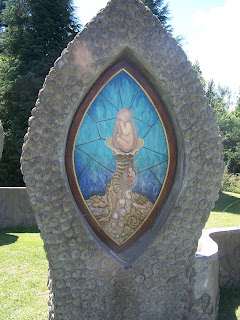
 One of the really interesting attractions at Hogsback is an eco-shrine built by Diane Graham. Diane is a deeply spiritual woman whose love of nature and art is very intense. She spends her days painting panels that she then exhibits in monuments surrounding a pool in her garden. On the front of each form is a painting connecting nature and humanity; inset on the back of each one is a traditional San (bushman) mosaic devoted to a similar theme.

 Hogsback has some very quaint buildings, especially its church and the library shown below, which is located on a path leading towards Never Daunted.
 Most of the people at Hogsback are Xhosa who work in forest or a related industry. They seem to be a friendly lot; the ones that we talked to were clearly very proud of the low crime rate in the village. Nancy and I were assured that walking home at night from one of the restaurants was perfectly safe. Even Hogsback, however, is not without its crime. Occasionally, people (black and white) are murdered. There was an elder in the black community who was highly respected by both his own people and the whites in the area. He often served as an mediator in any disputes that arose. One day he was attempting to resolve an argument outside of the post office and was stabbed to death...by his own son.
 So many of the local people in Hogsback went out of their way to help us. When we arrived, our bags hadn't even left the driveway before a man named Mike took us for a one hour drive to show us as many of the trailheads and pathways as he could. A couple that we met named Ken and Sonaya spent an afternoon hiking with us and driving us up to the alpine meadows to look for wild horses and Jackal buzzards. We'll have a photo of them to share at a later date. The owners of Never Daunted were exceptionally kind and hospitable. Saying the traditional farewells ("Stay well" followed by "Travel well"") were very difficult for us. But what is life if not a complex chain of hellos and goodbyes?
e
re

 Buccaneers began as a pretty simple establishment built upon little more than a reinforced sand dune at a village called Cintsa, 25 km north of the bustling city of East London. It was originally a series of family cottages built above a river mouth on the Indian Ocean. When apartheid ended and South Africa became a democracy in 1994 there was a degree of hysteria among affluent whites based upon a perception that their wealth and security would inevitably erode. This proved to be disasterous for tourism, particularly in areas such as this which are predominantly black; people stopped coming and the business was in trouble.
 One of the reason that Buccaneers has done so well as a backpackers is that the quality of the room is very high, mostly ensuite cottages overlooking the mouth of the river and the sea. The view from our little deck was wonderful - a great place to relax and just watch the waves roll in.
  Buccanneers is also famous on the South African backpackers' scene because of the range of experiences it offers. Pay-as-you-go activities include surfing school, horseback riding, cliff-climbing, guided hikes, quad biking, climbing wall, and excursions into a local game park. There is also a weekly trip to a rural school project that the Prices help to sponsor. Daily activities that are free are canoeing on the river and an afternoon fun group event such as a swimming pool game or volleyball...all of which come with complimentary wine for each participant!
 The sub-tropical climate lends itself to new varieties of flora. We took great delight in the purple flowering vines that fringed many of the sand dunes along the beach, and the bird-of-paradise that grew abundantly throughout the property.
 Cintsa is about a thirty minute drive past East London, one of South Africa's largest cities. We are now in an area that fell under British control during the colonial era. The Boers (farmers of Dutch descent) had much earlier spread eastward from Cape Town then began to head north in search of new lands to inhabit. One of the reasons that they had not progressed much past the Fish River was that the land was extensively occupied by the Xhosa, one of the two main black nations of people living in South Africa.
 Nancy and I are both looking forward to having more contact with the black people of South Africa as we move north along the east coast. It was a real pleasure to meet Omnatee and Melanie, two of the receptionists at Buccaneers. Both women were very friendly, helpful, enthusiastic, and very articulate.

 Then, providing us with an opportunity to get even more "up close and personal", the younger bull got down on the ground, enabling us to stroke its back and ears! AHHHHHH!
 Here's some interesting elephant trivia to leave you with. Elephants: live up to 70 year of age; have poor eyesight but excellent hearing. They can communicate messages (to other elephants 8 km away) by stomping their feet. The elephants are right or left tusk dominant and consume 250 kg of vegetation daily; can take 8 litres of water into their trunk at a time; cannot breathe through their mouth. Like humans, they do have food preferences and DO have an incredible power of memory. We heard stories of elephants remembering a trainer and specific commands after 16 years of separation! I can't speak for the elephants but I know this was one amazing experience that I will NEVER FORGET!
 Prior to our trip to the Otter Trail we stayed at a place called Hiker's Haven. It's a family home that gets rented out part of the year to help pay the bills. Nearly all of the houses in Nature's Valley are guesthouses of some sort. People told us that they come every year - that it is one of the few places in South Africa where they feel that they can let their kids play more or less unsupervised. Indeed, Jacques (one of the owners) told us that they hadn't locked the doors during twenty years of living there. The doors to the rooms are traditional Dutch - split into a lower and upper half. The upper half is usually left wide open to allow air to circulate but does little to prevent a rogue baboon from making the rounds every few days and stealing all of the sugar, coffee and anything else available on a complimentary tea and food tray. The owners get mad but don't solve the problem, continuing to leave the doors open! I guess old habits are hard to break.
 The Otter Trail is unidirectional so it's necessary to get a shuttle to drive the thirty minutes to Storm's River. The entire area is quite spectacular - never a dull view!
 The Otter Trail is about a 42 kilometer hike - not very far but with little flat terrain - lots of climbs up and down. The
  The views along the trail are simply gorgeous. The surf churns, foams and crashes relentlessly

 There are countless caves to explore along the way...
 and plenty of waterfalls that tumble over the sides of the cliffs.
 The water in the rivers were a welcome relief from the heat. The brown colouration is tannin, a nature pigment from dissolved vegetation. The water is pure and fit to drink.
  Large pinnacles of rock provide fantastic vistas along the coast...


 We witnessed dolphins breaching and some pretty exotic species of birds but most of the wildlife that we saw along the trail was a variety of sea birds like cormorants and oyster catchers. Our most constant companions were large (4-5 inch) colourful grasshoppers that seemed to be everywhere. They tried to avoid us for the most part but Nancy did get quite anxious when she found one of these "babies" as well as "mom" (even larger) crawling along her arm!
  Needless to say we observed many spectacular varieties of wild flower that we had never previously encountered. The most unique species was one that was growing near the station near the entrance to the gateway to the park.
  The rivers that we had to cross became increasingly difficult. Two in particular seemed rather impossible to contemplate at mid or high tide. Strong tides met the flowing rivers in a pretty impressive two-punch made even more intimidating by the high rocky cliffs on either shore.
 Our fellow hikers had something called a survival bag into which they could pack their k
 The South Africans (currently living in Pretoria and Swaziland) told us all kinds of interesting stories about natural dangers (snakes) as well as human (crime) from South Africa and further afield. Perhaps the strangest (which they swear is true) comes from a
 We finished the Otter Trail in good spirits and not too much discomfort. The tradition for hikers is to head immediately to the only local restaurant where you have the option of leaving one or both of your worn-out boots in the tree located with
 The closest that we got to experiencing a
  Thanks for taking the time to read the blog. We hope that all friends, family and colleagues are well and looking forward to the arrival of spring in the Great White North.

