Pictured below is one of the more famous views within Kruger, witnessed from the balcony at the Olifants (elephants) Rest Camp. It's a great spot for viewing crocodiles, hippos, grazing animals and, if your timing is really great, the occasional lion kill.

One of the features that makes Kruger an especially exciting place to visit is the series of paved and graded secondary roads leading to high quality facilities that make it perfect for self-drive tours. The different destinations are well-posted. Apart from a few rest stops that are strategically located between the rest camps, there are no places to stop. You are not allowed out of the car except in the middle of some of the longer bridges (at your own risk); in fact, people have been fined just for leaning out a window or sunroof, which is also forbidden. Being more or less alone to take on the wilds of Africa was a highly exhilarating experience!
 Those of us who grew up in the 1960s will remember Mutual of Omaha's Wild Kingdom. Every Sunday afternoon it brought timeless stories about African wildlife, principally from Kruger National Park, into our living rooms. I recall being fascinated by the scenery and wildlife of a far away land. In many ways it served as a comprehensive introduction to exotic flora, fauna and ecology. Images of thousands of wildebeest simultaneously thundering across the savanna to elude lions really stuck in my mind. Although herds this size are more typical of eastern Africa, we certainly saw a lot of this powerful beast.
 Exposure to game such as antelope, zebra and giraffe began within minutes of driving through the camp gate. Following check-in and some lunch at Berg-en-dal Rest Camp we set off on a late afternoon drive. It wasn't very long before we meandered by what we initially thought to be the alternate black and white pattern of a zebra. Upon further inspection we realized that it was the carcass of a half-eaten elephant. Most of the rump and sides were gone but the head was entirely intact as well as parts of the upper torso. Lions were in the long grass nearby, out of sight.
  One of the hard and fast rules at Kruger is that you must be in your rest camp between dawn and dusk. Heavy fines are applied to those who fail to comply. Reluctantly, we had to head for home before supper time arrived in the jungle. Up early the next morning, we headed directly back to the site. By 6:15 A.M., however, the feast was pretty much over. The last spotted hyena had waited its turn but now abandoned the kill, stopping for a few moments on the road to observe the tourists.
  For the next twenty minutes we watched as a squadron of vultures took turns finishing up the remains. There wasn't much left except the bones; no doubt that by now they are pretty much gone as well!
  We really weren't sure how much wildlife we could expect to see at Kruger, but it fulfilled our wildest dreams. We took so many great photos that it's hard to know which ones to share. I guess I'll try to provide a sample of the amazing variety we encountered, both big and small.
Being restrained by the electronic fences at the rest camps not only provides safety to tourists but also protects the wildlife. We thought it was quite amazing that after four days of driving we did not see a single victim of roadkill. The speed limit of 40 k.p.h. helps to protect those who need to find their way across, such as the ever-so-slow chameleon that we saw on a number of occasions.

On the other hand, the dung beetle really is an amazingly energetic creature. Its preoccupation is with rolling animal waste (mostly from the elephant) into neat little balls which it nimbly (and no doubt proudly) brings to the supper table. Nancy and I were both impressed at how fast the beetles flew across the road!
 The bird life at Kruger is absolutely extraordinary, easily worth the price of admission on its own. There are some 500 species of our feathery friends in the park. One of the most beautiful is the ubiquitous lilac-breasted roller. As part of its mating ritual the males soars high into the air, somersaults around a few times, then drops like a stone as it comes roaring back to the earth. What girl wouldn't fall for that? Although we didn't see this aerial spectacle, I can tell you that the full blue of the entire back and wing feathers are a sight to behold when the roller takes flight!
Another very common species was the Southern Carmine Bee-Eater. One can't help but be impressed with its exceptional reflexes as it snacks bees right out of mid-air!
 The trouble maker of the bunch seemed to be the Southern Yellow Hornbill. It always had a lot to say, pestered smaller animals like the mongoose, and relentlessly divested insects from their homes. In a children's book in a gift shop we were amused but not surprised to see that it was cast in the role of the villain. During mating season the male digs a hole for its mate, plasters her into it with mud and sticks, then brings food during the weeks required for the eggs to be incubated and hatched. During this time the female loses her feathers, which are quickly regrown when she is released from her lonely vigil.
 One of our most awesome wildlife observations was watching an unspecified species of eagle (all we saw was the silhouette) as it slowly dissected and wolfed down a large snake that it had just airlifted from the dusty soil. By the time this picture was taken, a good 15-20 cm of snake had already disappeared "down the hatch".
  There were quite a few aquatic species to be seen where ever water was able to accumulate. A particularly lovely marsh bird was the saddle-back stork.
  We had some unforgettable moments with some of the large mammals in the park. We saw a lot of elephants but this one was about as close as you can get to the animal without being stepped on. Although they are generally mild-mannered beasts, elephants can go on a rant as well as anyone. At one rest site there was a picture of an overturned, the result of getting too close and being charged. We really weren't being irresponsible to get ourselves into this predicament. The creature appeared suddenly was so close to the road it was hard to avoid. It started flapping its huge ears at us. This means one of two things: the flies are bothering me or get out of my face before I hurt you!
 Normally, rhinos are spotted grazing lazily amongst the underbrush. They're more active at night but are generally taking their time then too. It was nice to see them in motion, straight ahead, as we drove drove down a quiet side road. We soon became aware that they were running, not walking. To our amazement they came rumbling right up to the car (within five meters!) before exiting into the field shown here. As most people know, a rhino can generate quite a head of steam. As if playing, they cantered around the field in a figure eight pattern before heading straight at us again. This time they got so close that we dropped the camera (we attempting a video) and rolled up the window (not that this would do much good) before they veered off and darted into the bush!
 Kruger is know for its large cats and although we didn't see any lions or cheetahs, we saw a couple of leopards. It's mostly a matter of luck. The first few days we did everything right, starting early, being quiet, and driving slowly (inspecting, at times, every limb). By the last full day we had been shut out except for one leopard that a flock of people told us was resting under a large bridge we traversed. By this time I had contracted tick fever (common in these parts). Not feeling well at all caused us to start late and drive quickly, not really even observing very carefully as we hurried to get to a doctor.
Not five minutes outside of Olifants (where leopards are not officially listed as present), out of the corner of my eye I saw this magnificent feline suddenly appeared out of the grass. Breaking to a halt, the cat walked slowly across the road right behind us then proceeded to lay down in the grass at a distance of about twenty metres to preen itself. We watched for a good ten minutes before it tired of all the other vehicles which began to arrive, an strode off into the higher grass. It was quite a thrill! As for the tick fever, for a few days I was pumping so many pills that one morning I woke up thinking I was Keith Richards, but thankfully, it lasted less than a week.
 I could go on and on about all of the various kinds of antelope we saw as well as a host of other delightful animals but I should think this is enough for you to get a feel for the wonderful time that we had at Kruger. Those who are interested can see more when we get home. Amazingly enough, a few short years ago business conglomerate was nearly successful in buying Kruger to build resorts and even a golf course. Fortunately, a groundswell of public opposition put an end to that. Funding for conservation is a big issue in South Africa though as so much of the national income is being devoted to much-needed social programs.
Thanks for continuing to read the blog - the big gaps in publication are a reflection of our timetable and Internet availability rather than a commitment to the cause. Will be posting again very soon so stay tuned!

 People seem to go out of their way to make the landscape lovely. Colourful shrubs line many of the fields, especially the sugar cane plantations.
 The fields are lush and there are a variety of large and carefully manicured orchards such as this grove of papaya trees.
  The
The 
 There are lots of interesting African crafts available. Since we're starting to get nearer to the end of our trip we're starting to look at these more carefully.
 The region has some gorgeous fauna has well as the flora.
 We recently spent a day driving the Panorama Route which includes wide-sweeping valleys the grandeur of which is difficult to convey in a single frame. The Three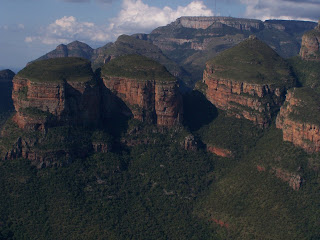
 The most unique and perhaps impressive spot along the route is at Bourke's Luck Potholes, a conglomeration of swirled out pockets in the rock caused by pebbles that once flowed with the force of the water. We loved the spot and have too many pictures that we'd like to share so will have to be content with posting just a few!


 By the early nineteenth century the Zulus began to overwhelm their adversaries. Shaka took few prisoners - defeated opponents were either absorbed into his battalions or killed. It time he assembled a standing army of forty thousand fighters into a military state akin to the Greek city of Sparta. Those who displeased him were either thrown into a crocodile pit or off a cliff north of Durban that is still called Shaka's Rock. After his mother (
 Unlike the exposed kraals of the
  Our tour of a traditional Zulu village included a number of interesting exhibitions of skill and ingenuity. The most impressive was the performance of a wedding ceremony that lasted just under half an hour!
  The Zulus' fascination with coloured beads dates to their earliest contact with European explorers. Their clothing and crafts use these to great effect.
 The
The  The park is most famous for its population of white rhino, which have thankfully been rescued from the brink of extinction. The park also has black rhino which are not only more irritable and dangerous but less easily spotted since they're not at all sociable except during mating season. The white rhino, though more docile, is actually much larger, a massive animal! This fellow made quite an effort to uproot a fence (
 Although the African buffalo made appear fairly harmless, it is one of South Africa's "Big Five" animals that are categorized not on the basis of size but degree of danger. The bulls are especially aggressive when they get older and are forced away from the heard by the younger males.
  There were many elephant, giraffe and zebra in the park. Often you don't have to look very far - the animals appear on the road and are fully accustomed to seeing vehicles and don't perceive them as a threat, as long as nobody gets out!
  I've often thought how exciting it would be to run into a wild boar so warthogs were fun to observe and very prevalent. The males have much bigger warts and horns than the females. They use a variety of techniques for digging up roots, grubs and whatever else they might fancy to eat. Sometimes they collapse their front legs and drill through the soil like a plough!
  We haven't really said much about South African birds, but believe me, there are plenty and they are really quite amazing. We'll post some photos in a later blog. I have to mention though that there's apparently no greater love in the world than that of the yellow weaver. At the outset of the mating season, the male builds a nest for the female. She's rather fussy: too small, too big, too round, not round enough, etc. By the end of the process this must be one tired bird!
 While in the area we visited Cape Vidal which is part of the St. Lucia Wetlands, a World Heritage Site. It has fabulous beaches (though now damaged and littered by the recent storms) and one of the most highly regarded sport fisheries in South Africa. The recent high seas and flooding have provided a real bonanza for those who like to fish!
  Finally, we spent a very entertaining afternoon in the area on a river boat cruise along the St. Lucia estuary. The mangrove swamps are beautiful and play a vital role in marine ecology. There were some very large crocodiles! Didn't see any crocodile tears but I think that this is as close as it gets to a crocodile smile. It happened as Nancy was relating to another tourist the story about Stephen Harper shaking hands with his children in the school yard!
 Nancy was in her glory with all of the

 The third largest urban centre in the country, Durban said to be a place of perpetual sunshine. We were, therefore, in for a bit of shock when we witnessed first-hand just how vulnerable any location can be to the destructive forces of nature. Approaching from the south late one evening, everyone on the
  When we arrived in the city centre a little before midnight the water was knee deep in all low-lying spots. Water streamed along the sidewalks as the
  One of the features that makes Durban an interesting place to visit is its Asian influence. East Indians account for a significant portion of the population. In fact, Durban is the world's largest Indian community outside of India itself! Many of people were originally brought to the country by the government to work in the sugar cane fields. This cash crop is still an important component of the local economy. The climate and soil must be very favourable -the plants have viewed have often been growing ten feet high!
 One
One  Nancy and I both enjoy Indian food a lot so we couldn't miss the opportunity to try Durban's favourite fast food - something called Bunny Chow ("bread-hot"). This consists of a chunk of bread that is hollowed out in the centre and filled with the curry of your choice...but no rabbit if that's what you're thinking. It's very tasty and filling!
 Along with the Indian culture comes its architecture. There are many impressive Hindu temples and Islamic mosques, particularly around the old quarter near the city centre. This is the
  A highlight of our trip to Durban was a visit to the Victoria Street Market. It's an intriguing blend of Indian shops as well as all things African. There are many women selling dresses on the sidewalks. It's a tradition in the Indian culture for the groom to buy his mother-in-law twenty dresses as part of the wedding package...so they do a pretty brisk business!
 That's not to say that all Indian men are infatuated with their new in-laws. They may, at times, seek revenge in the good old-fashioned Indian way in evidence at the spice market!
  The most disquieting part of the market was our stroll down what I will call, at the risk of sounding judgmental, "Voodoo Alley". It's an entire street devoted to the sale of ingredients used by African witch-doctors. Most rural black South Africans have no real access to medical care and rely upon the potions cooked up by these traditional "healers". The shops in the Victorian market actually provide wholesale supplies of raw materials for the witch-doctors in many African countries. Most of the businesses had a variety of mangled
 Most of the people in the
  We had an interesting conversation with the king of this niche. Like most of the other vendors, he works by day and sleeps at night in the market, which is as much his home as his place of commerce. He was very friendly and spoke some English. Mostly he wanted to know what sort of remedies we used for treating the ill in Canada. Nancy and I were at a loss when he asked us what goes into our enemas! As you can see, his torso was heavily scarred, which we instinctively attributed to some sort of pagan ritual, but was apparently the result of a car accident.
 Durban has many fine buildings from the English colonial era. In the city centre Francis Farewell Square square has a magnificent


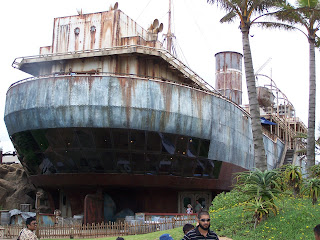 The sharks of Durban are legendary. There's a shark net set about 50 metres from shore or swimming and surfing would be impossible. The net gets checked every day but got completely washed away by the recent storms. Many of the creatures at Marine World (especially the sharks) are animals that are in captivity because got stuck in and injured by the net.
 Marine World is the fifth largest aquarium in the world. We simply ran out of time


