Being without Nancy was a big adjustment. There were also some initial organizational difficulties at the administration level of the tour that resulted in getting dumped in the desert for an afternoon after a five hour drive in extreme heat. An Australian woman who was in the same boat was also left baffled, without food, and not knowing who we were to meet or when they would arrive. It all worked out in the end due mostly to the efforts of our guide, Fisher, and his assistant, Jairos, who were terrific leaders and wonderful human beings. I quickly learned to respect their knowledge and appreciate the constant concern they showed for the security of their clients. Both are citizens of Zimbabwe. They taught me that Zimbabwe means "house of stone" in their language.

The trip southward through some very weathered-looking rock formations was not very comfortable but certainly was interesting. The stark beauty of a desert never ceases to amaze me. The Namib Desert, from which the country takes its name, is the oldest desert in the world. Eighty million years of arid conditions are the result of the warm dry winds caused by the Benguela current flowing southward in the Atlantic Ocean. Despite the extreme conditions (averaging less than 10 mm of rain per year) the struggle to adapt and survive is demonstrated by the little pockets of life that exist.
The main attraction in the south of the country is the towering dunes of Sossusvlei, which are believed to be the largest in the world. Viewed best at sunrise or sunset, the dunes morph through a variety of colours and shades under the changing light conditions. Steady winds ensure that the dunes are constantly shifting in size and location. Exploring the various dunes for the day was a lot of fun but very tiring. It takes a great deal of effort to scramble up a 250 metre dune in the hot sun! A special site among the dunes is a place called Dead Vlei (Dead Lake). Much of the Namib is built upon an enormous salt pan. These are very parched, white, and often cracked depressions in the land that have at times in the past contained salt water. As the water evaporated, the salt and other minerals were left behind to accumulate. These white soils provide an acute contrast to the red sand dunes. As you can see, Dead Vlei was once a lake that was able to sustain a small forest before an unusual period of rainfall drowned the trees.
Our hike to Dead Vlei was quite memorable. Due to a breakdown in communication we believed that the total hike to get there was five kilometres. It turned out to be ten kilometres long up and down dunes through the sand. Most of us had insufficient water as morning turned to mid-day. I can only recall one other time in my life when I have felt so dehydrated!
A special site among the dunes is a place called Dead Vlei (Dead Lake). Much of the Namib is built upon an enormous salt pan. These are very parched, white, and often cracked depressions in the land that have at times in the past contained salt water. As the water evaporated, the salt and other minerals were left behind to accumulate. These white soils provide an acute contrast to the red sand dunes. As you can see, Dead Vlei was once a lake that was able to sustain a small forest before an unusual period of rainfall drowned the trees.Our hike to Dead Vlei was quite memorable. Due to a breakdown in communication we believed that the total hike to get there was five kilometres. It turned out to be ten kilometres long up and down dunes through the sand. Most of us had insufficient water as morning turned to mid-day. I can only recall one other time in my life when I have felt so dehydrated!
The camel thorn tree is one of the rare forms of fauna of any size that grow among the dunes. Many desert species depend upon the camel thorn. It provides shade as well as a home for insects and reptiles. 
The bark, leaves and sap provide sustenance for a variety of species. The pods it produces are also a key source of food. These pods are known as camel's toe.
 The gemsbok (oryx) is a highly specialized antelope that lives in the Namib Desert and throughout most parts of the country. It's main source of food? The pods of camel's toe! The gemsbok has the uncanny ability to survive for long periods of time without water. It is able to let its body temperature climb to levels that would kill most mammals. Rather than drink it consumes the traces of dew that form on the desert plants late at night and early in the morning. Indeed, many of the species in the Namib rely on the moisture provide from fog which rolls in off of the Atlantic Ocean on a fairly regular basis. As we travelled along in our safari truck, a gemsbok by the side of the road got spooked and raced the vehicle flat out for about 100 metres. That was an image that I'll never forget!
 Other common animal species that we saw in the desert were ostriches and the black-backed jackals. They seemed to always be on the prowl and visited the campsites from dusk until dawn. Each night we could hear them howling and growling back and forth. What a mess they made at one site where the campers (us) forgot to stow the garbage inside the truck!
 Another world class attraction in this area is the Sesriem Canyon. It's a one kilometre long, 40 metre deep cleft in the desert floor that provides quite a few corridors for exploring. The small amounts of water which accumulate here provide a micro climate for some species to survive. Sesriem is Africaans for "six thongs", the length of six leather cords that the Voortrekers had to lower into the canyon to gather water.
As we proceeded further northward in the desert, a second kind of tree began to appear. It is called the quiver tree, so named because the bushmen used it for creating the sheaths for their poison arrows upon which their hunting endeavours depended.
An interesting species of bird called the sociable weaver manages to survive under these harsh conditions. The birds start off building their nests individually but eventually they meld into
one. This helps to insulate them from the sometimes cold winter nights, snakes, and wasps. I'd imagine it leads to some pretty good parties as well! After a few days of gruelling desert heat we were all feeling relieved when we arrived at Walvis Bay. During the past hour of driving the temperature had dropped so dramatically that most of the people on the tour donned sweaters or jackets. Walvis Bay is Namibia's only deep water port. It has also become a rapidly developing tourist location that is well-known for its pelicans and flamingos.
  A short drive north of Walvis Bay, we arrived in the city (really a small town) called Swakopmund. Its extensive beaches help to draw many visitors from Europe, mostly Germany. Namibia became an independent country in 1990. For many years it was a German colony. Later, as a protectorate of South Africa, it served as a buffer between the South Africans and their adversaries in the Angolan War of Independence. The Angolans sent their colonial masters (Portugal) packing and began a war of liberation in surrounding countries. The leader of the guerrilla group (MPLA) was killed just two years ago and there remain today some pockets of armed resistance.
  The condition of Nancy's mother having stabilized somewhat, with some uncertainty I decided to finish the safari. Leaving Swakopmund was the point of no return as we headed of into some serious wilderness in the region known as Damaraland, after the Damara people. Our first stop was at a place called Twyfelfontein. This is the scene of the greatest collection of ancient San rock engravings in Africa, soon to be a World Heritage Site. The San lived in the area during the dry season since there is a nearby spring. The engravings are not only impressive in number but are well-preserved compared to rock paintings which deteriorate more over time.
  Tourism has quickly become Namibia's second largest industry, after mining. The country boasts the world's largest uranium mine, the largest and best diamonds deposits, tungsten, silver and a wide variety of other precious metals. Hawking samples of stone is thus one means for people to scrape a living off the land. As we headed northward it was easy to see that day-to-living is very difficult for the majority of the desert population. Homes were smaller and more simple than I had seen elsewhere in southern Africa.
 This region is occupied by a number of tribes. The Herero women are known for their beautiful dresses as well as their head wear. A married woman sports a hat that is adorned with a fixture in the shape of bull horns. These represent the cattle that the husband had to pay for his woman.
 After visiting a number of interesting rock formations such as the Organ Pipes we paid a visit to a petrified forest. The semi-buried mineralized trees were huge pine that once got washed down from Angola and became lodged in the soil. What an exciting experience - it's not every day that you get to hold chunks of a 350 million-year-old tree in your hands!

After a few days of gruelling desert heat we were all feeling relieved when we arrived at Walvis Bay. During the past hour of driving the temperature had dropped so dramatically that most of the people on the tour donned sweaters or jackets. Walvis Bay is Namibia's only deep water port. It has also become a rapidly developing tourist location that is well-known for its pelicans and flamingos. A short drive north of Walvis Bay, we arrived in the city (really a small town) called Swakopmund. Its extensive beaches help to draw many visitors from Europe, mostly Germany. Namibia became an independent country in 1990. For many years it was a German colony. Later, as a protectorate of South Africa, it served as a buffer between the South Africans and their adversaries in the Angolan War of Independence. The Angolans sent their colonial masters (Portugal) packing and began a war of liberation in surrounding countries. The leader of the guerrilla group (MPLA) was killed just two years ago and there remain today some pockets of armed resistance. The condition of Nancy's mother having stabilized somewhat, with some uncertainty I decided to finish the safari. Leaving Swakopmund was the point of no return as we headed of into some serious wilderness in the region known as Damaraland, after the Damara people. Our first stop was at a place called Twyfelfontein. This is the scene of the greatest collection of ancient San rock engravings in Africa, soon to be a World Heritage Site. The San lived in the area during the dry season since there is a nearby spring. The engravings are not only impressive in number but are well-preserved compared to rock paintings which deteriorate more over time. Tourism has quickly become Namibia's second largest industry, after mining. The country boasts the world's largest uranium mine, the largest and best diamonds deposits, tungsten, silver and a wide variety of other precious metals. Hawking samples of stone is thus one means for people to scrape a living off the land. As we headed northward it was easy to see that day-to-living is very difficult for the majority of the desert population. Homes were smaller and more simple than I had seen elsewhere in southern Africa.This region is occupied by a number of tribes. The Herero women are known for their beautiful dresses as well as their head wear. A married woman sports a hat that is adorned with a fixture in the shape of bull horns. These represent the cattle that the husband had to pay for his woman.After visiting a number of interesting rock formations such as the Organ Pipes we paid a visit to a petrified forest. The semi-buried mineralized trees were huge pine that once got washed down from Angola and became lodged in the soil. What an exciting experience - it's not every day that you get to hold chunks of a 350 million-year-old tree in your hands!Heading further north we camped among the rugged and remote Spitzkoppe Mountains. This was a very dramatic setting, nestled in the middle of a diverse variety of picturesque rock formations that included distant plateaus, widely distributed boulders of varying size, and smoothly carved pinnacles once subject to the ebb and flow of the currents while submerged in the ocean. The atmosphere was bone dry, the air pristine and the entire landscape silent. One of the features looked very much like Ayer's Rock and manifested the same glow in the setting sun as we climbed to the top.
In the opposite direction was a rock face known locally as the Matterhorn since it is thought to resemble the peak of that oh-so-famous mountain in Switzerland.

Our next cultural encounter was really quite special. There's a semi-nomadic people in northern Namibia called the Himba. They like to keep to themselves for the most part but we were able to visit a village that had really only had much contact with outsiders for the past three years. The tribe is particularly know for the beauty of its women. Although their clothing is rather simple they go to great lengths to decorate themselves. The woman combine their natural hair with that of animals to create a braid, apply animal fat, ash, then ochre. At the age of 8-10 years males and females alike have their middle four lower teeth removed. This is considered to improve their appearance, enable them to enunciate their language more effectively, and help to differentiate them from other tribes. Our guide was dressed in western clothing and no longer lived with the Himba. He ran away at adolescence when some of these traditional rituals begin! During our visit most of the women were busy making butter out of goats' milk by gently rocking their pots back and forth in a pendulum-like motion.
 Since water is such a precious commodity to the Himba, it should really be no surprise that they do not use it for bathing. Instead, animal fat is mixed with ochre and this is they rub on their bodies daily. It helps to block the sun, discourage insects, and is considered to be beautiful.
Smoke is also used as a means to keep clean. When the woman pictured below finished preparing the ashes she raised her skirt and then hovered on her knees above the smoke, something that is done for up to an hour per day. This was quite a shock to a few of the French people in our ensemble. Indeed, since the earliest days of colonialism is southern Africa, when the Dutch arrived at the cape, personal hygiene has been a contentious issue. The Europeans considered the practice of applying animal fat to the body to be barbaric and disgusting. The native people were equally as disapproving of the use of scrubbing with water, which they saw as very odd and ineffectual for their needs. I guess it all depends on what you're used to!
 The last but not least of the local visitations on the tour agenda was with the San (bushmen) at Tsumeb. I had anticipated that the three hour tour would involve a long walk in the desert somewhere. I think that we were all a little disappointed to learn that our walk was to be along a tourist-oriented trail through the forest adjacent to the village. Nevertheless, the event turned out to be educational and interesting.
 Paul was a young man who was fascinated by and dedicated to learning many of the traditions of his ancestors. To him they were a very advanced people far more competent than himself at surviving in the world. The local tribe had been resettled outside of their traditional lands when the apartheid government created Etosha National Park (without compensation) thus many ancient skills are now being lost. During the excursion we were told about the many uses of the plants and shrubs in the vicinity then were shown how to make and successfully operate a simple snare to catch a guinea fowl. Paul also demonstrated the construction of different tools and weapons as well as the many uses of an ostrich egg. He finished by making a fire with two sticks and some dry grass. This involves some pretty hard work!
 We also learned the ins and outs (literally) of how to make a termite trap. Termites are considered to be a real treat in the community, so much so that termite mounds are individually owned and operated. Just twice per year newly born termites leave the nest and are attracted to the bound sticks that are set afire above the pit. In their quest for light they fall into the hole and are collected in a bag. A good haul is about twenty kilograms! The termites are fried or roasted in the sun before being shared with the neighbours.
The San were notorious for their ability to track game. Paul showed us some common types of animal tracks and told us some interesting stories about living along the Angolan border. Growing up during the Angolan Civil War he was instructed to run and hide in the bush whenever he heard a vehicle approaching on the road. A trick that the rebels used to elude the South African forces was to remove the soles of their shoes and reattach them backwards to disguise their direction of travel. The San were able to help the South African army by detecting the weight distribution on the imprints to get a true reading of troop movement.

The last part of our journey through Namibia was along the Caprivi Strip. This is a sliver of land that was once politically independent. When the Germans were masters of Namibia they decided that it would be really nice to have access to the Zambizi River further to the east. The German Count von Caprivi did the negotiating with the other European powers of the time so the land was named after him.
There's lots of game in the area and its pretty wild (i.e. dangerous) - no fences, electric wires or conservation authorities. We had a terrific power boat tour of the waterways on the Kwando River. There are plenty of crocodiles and hippos in the area! On December 24, 2005 one of the locals was in the water with a net trying to catch some extra fish to sell for Christmas. He got snapped up be a four-metre crocodile. When the government asked for proof of cause of death they killed a baboon and used it as bait. It didn't take long for the croc to gobble it down. After capturing it they cut it open and found the man's legs in the belly. Apparently the rest had been stolen in a croc feeding frenzy.
Most of us were brave enough to swim in this protected (caged-in) pool set in the river. The water flows very quietly but forcefully - it was a great workout trying to swim against the current.
 There were a few nights in which most of the people on the safari were awfully scared to leave their tents. One night a big sign warned people about elephants and hippos moving through the campground at night. This was also a vintage malarial area. Someone in Africa dies of malaria every thirty seconds! It was the first time in my life that I can recall applying insect repellent to virtually every inch of my body.It's pretty hard to sleep you when you hear a few mosquitoes buzzing around and the grunt of a hippo no more than a stone's throw away! One night I ventured out at about 3:30 A.M., inching my way to the washroom then dodging and weaving my way back. There were some pretty heavy snorers in our group, their sounds often barely distnguishable from the sounds of the night!
 Before heading to Zambia we finished Namibia with an enjoyable paddle in dug out canoes called the upper delta of the Okavango River . It was lots of fun, saw some hippos up close and personal and we all finished just happy to be safely on terra firma once again!


 Those of us who grew up in the 1960s will remember Mutual of Omaha's Wild Kingdom. Every Sunday afternoon it brought timeless stories about African wildlife, principally from Kruger National Park, into our living rooms. I recall being fascinated by the scenery and wildlife of a far away land. In many ways it served as a comprehensive introduction to exotic flora, fauna and ecology. Images of thousands of wildebeest
  Exposure to game such as antelope, zebra and giraffe began within minutes of driving through the camp gate. Following check-in and some lunch at Berg-en-
 One of the hard and fast rules at Kruger is that you must be in your
  For the next twenty minutes we watched as a squadron of vultures took turns finishing up the remains. There wasn't much left except the bones; no doubt that by now they are pretty much gone as well!
  We really weren't sure how much wildlife we could expect to see at Kruger, but it fulfilled our wildest dreams. We took so many great photos that it's hard to know which ones to share. I guess I'll try to provide a sample of the amazing variety we encountered, both big and small.
 The
The 
 The trouble maker of the bunch seemed to be the Southern Yellow
  One of our most awesome wildlife observations was watching an unspecified species of eagle (all we saw was the silhouette) as it slowly dissected and wolfed down a large snake that it had just airlifted from the dusty soil. By the time this picture was taken, a good 15-20 cm of snake had already disappeared "down the hatch".
  There were quite a few aquatic species to be seen where ever water was able to accumulate. A particularly lovely marsh bird was the saddle-back stork.
  We had some unforgettable moments with some of the large mammals in the park. We saw a lot of elephants but this one was about as close as you can get to the animal without being stepped on. Although they are generally mild-mannered beasts, elephants can go on a rant as well as anyone. At one
  Normally, rhinos are spotted grazing lazily amongst the underbrush. They're more active at night but are generally taking their time then too. It was nice to see them in motion, straight ahead, as we drove drove down a quiet
  Kruger is know for its large cats and although we didn't see any lions or cheetahs, we saw a couple of leopards. It's mostly a matter of luck. The first few days we did everything right, starting early, being quiet, and driving slowly (inspecting, at times, every limb). By the last full day we had been shut out except for one leopard that a flock of people told us was resting under a large bridge we traversed. By this time I had contracted tick fever (common in these parts). Not feeling well at all caused us to start late and drive quickly, not really even observing very carefully as we hurried to get to a doctor.
 People seem to go out of their way to make the landscape lovely. Colourful shrubs line many of the fields, especially the sugar cane plantations.
 The fields are lush and there are a variety of large and carefully manicured orchards such as this grove of papaya trees.
  The
The 
 There are lots of interesting African crafts available. Since we're starting to get nearer to the end of our trip we're starting to look at these more carefully.
 The region has some gorgeous fauna has well as the flora.
 We recently spent a day driving the Panorama Route which includes wide-sweeping valleys the grandeur of which is difficult to convey in a single frame. The Three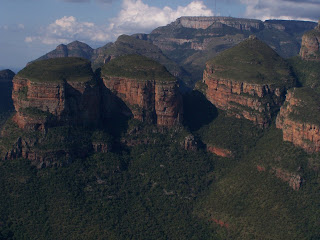
 The most unique and perhaps impressive spot along the route is at Bourke's Luck Potholes, a conglomeration of swirled out pockets in the rock caused by pebbles that once flowed with the force of the water. We loved the spot and have too many pictures that we'd like to share so will have to be content with posting just a few!


