For a long time the Zulu were a rather insignificant tribe among the Nguni peoples who had migrated into southern Africa. Their rise can be attributed to a rather cunning and ruthless individual named Shaka, who is an icon in South African history. Shaka grew up as a rather isolated child who was ostracized by virtually all of his peers. While learning the means of contemporary warfare he observed that long shafted spears were of limited value since they were cumbersome at short range and not easily re-used. He devised something called an assegai which is a short spear that can be used in close encounters. The application of this new weapon in hand-to-hand combat would, of course, require a high degree of bravery - something that Shaka had developed though years of having to defend himself. Below is an artist's rendition of Shaka taken at a waterfront warehouse in Durban.
 By the early nineteenth century the Zulus began to overwhelm their adversaries. Shaka took few prisoners - defeated opponents were either absorbed into his battalions or killed. It time he assembled a standing army of forty thousand fighters into a military state akin to the Greek city of Sparta. Those who displeased him were either thrown into a crocodile pit or off a cliff north of Durban that is still called Shaka's Rock. After his mother (Nandi) died Shaka executed hundreds of women and children who in any trivial way offended the memory of his mother. In time Shaka was murdered by his half-brother, Dingane, who more or less continued his policies. The Zulus were eventually defeated by the Boers and British but not before they had scored some convincing victories.
When we arrived at the entrance to a cultural village we were greeted by a fearsome warrior. His ability to remain in role was very impressive - no smiles (even though it may appear so in the photo), just lots of clicks of the tongue, forceful gestures, intimidation tactics, and impatience with our seemingly slow mastery of the basic Zulu words and greetings that he expected us to learn. Zulu rondavels are very sturdy and built in the shape of beehives. The entrance doors were intentionally kept low to force any visitor to bow while entering.
 Unlike the exposed kraals of the Xhosans, the Zulus had more highly organized villages that were surrounded by fences.
  Our tour of a traditional Zulu village included a number of interesting exhibitions of skill and ingenuity. The most impressive was the performance of a wedding ceremony that lasted just under half an hour!
  The Zulus' fascination with coloured beads dates to their earliest contact with European explorers. Their clothing and crafts use these to great effect.
  Hluhluwe (shla-shloo-wee)-Umfolzi National Park is one of South Africa's best game reserves. It was once kept as Shaka's exclusive hunting ground. The wildlife we saw during our day safari was a real thrill. Most numerous were the antelopes, of which South Africa has a wide variety. Each has different markings and a unique diet so that they're not all trying to eat the same plants! This is a female nyala, easily identified by its red coat and vertical white stripes.
  The kudu, though also vertically striped, is darker and larger. The male has a very impressive set of horns.
  The park is most famous for its population of white rhino, which have thankfully been rescued from the brink of extinction. The park also has black rhino which are not only more irritable and dangerous but less easily spotted since they're not at all sociable except during mating season. The white rhino, though more docile, is actually much larger, a massive animal! This fellow made quite an effort to uproot a fence (using it as a scratching post) that had been built to protect a plant research site.
  Although the African buffalo made appear fairly harmless, it is one of South Africa's "Big Five" animals that are categorized not on the basis of size but degree of danger. The bulls are especially aggressive when they get older and are forced away from the heard by the younger males.
  There were many elephant, giraffe and zebra in the park. Often you don't have to look very far - the animals appear on the road and are fully accustomed to seeing vehicles and don't perceive them as a threat, as long as nobody gets out!
  I've often thought how exciting it would be to run into a wild boar so warthogs were fun to observe and very prevalent. The males have much bigger warts and horns than the females. They use a variety of techniques for digging up roots, grubs and whatever else they might fancy to eat. Sometimes they collapse their front legs and drill through the soil like a plough!
  We haven't really said much about South African birds, but believe me, there are plenty and they are really quite amazing. We'll post some photos in a later blog. I have to mention though that there's apparently no greater love in the world than that of the yellow weaver. At the outset of the mating season, the male builds a nest for the female. She's rather fussy: too small, too big, too round, not round enough, etc. By the end of the process this must be one tired bird!
 While in the area we visited Cape Vidal which is part of the St. Lucia Wetlands, a World Heritage Site. It has fabulous beaches (though now damaged and littered by the recent storms) and one of the most highly regarded sport fisheries in South Africa. The recent high seas and flooding have provided a real bonanza for those who like to fish!
  Finally, we spent a very entertaining afternoon in the area on a river boat cruise along the St. Lucia estuary. The mangrove swamps are beautiful and play a vital role in marine ecology. There were some very large crocodiles! Didn't see any crocodile tears but I think that this is as close as it gets to a crocodile smile. It happened as Nancy was relating to another tourist the story about Stephen Harper shaking hands with his children in the school yard!
 Nancy was in her glory with all of the hippopotamus sightings. We had an extraordinary and lengthy visit with a colony of these amazing beasts which actually kill more people than any other animal in Africa! They're not too aggressive in the water.
The animal has an entirely different demeanour on land - so don't mess with a hippo! How's this for a teacher look? Our guide provided us with many interesting facts. The quality of a hippo tusk is considered to be the best in the world. That of a walrus is second, the elephant third, the sperm whale fourth. The rhino doesn't have an ivory tusk- its horn is made out of matted hair. I'm sure that Nancy will shared lots of interesting hippo news with everyone when we get home. 
Instead of dreaming about life in Canada tonight our minds may be full of Zulu visions and things that go bump in the water. May your nights be more restful! Thanks for reading!

 The third largest urban centre in the country, Durban said to be a place of perpetual sunshine. We were, therefore, in for a bit of shock when we witnessed first-hand just how vulnerable any location can be to the destructive forces of nature. Approaching from the south late one evening, everyone on the
  When we arrived in the city centre a little before midnight the water was knee deep in all low-lying spots. Water streamed along the sidewalks as the
  One of the features that makes Durban an interesting place to visit is its Asian influence. East Indians account for a significant portion of the population. In fact, Durban is the world's largest Indian community outside of India itself! Many of people were originally brought to the country by the government to work in the sugar cane fields. This cash crop is still an important component of the local economy. The climate and soil must be very favourable -the plants have viewed have often been growing ten feet high!
 One
One  Nancy and I both enjoy Indian food a lot so we couldn't miss the opportunity to try Durban's favourite fast food - something called Bunny Chow ("bread-hot"). This consists of a chunk of bread that is hollowed out in the centre and filled with the curry of your choice...but no rabbit if that's what you're thinking. It's very tasty and filling!
 Along with the Indian culture comes its architecture. There are many impressive Hindu temples and Islamic mosques, particularly around the old quarter near the city centre. This is the
  A highlight of our trip to Durban was a visit to the Victoria Street Market. It's an intriguing blend of Indian shops as well as all things African. There are many women selling dresses on the sidewalks. It's a tradition in the Indian culture for the groom to buy his mother-in-law twenty dresses as part of the wedding package...so they do a pretty brisk business!
 That's not to say that all Indian men are infatuated with their new in-laws. They may, at times, seek revenge in the good old-fashioned Indian way in evidence at the spice market!
  The most disquieting part of the market was our stroll down what I will call, at the risk of sounding judgmental, "Voodoo Alley". It's an entire street devoted to the sale of ingredients used by African witch-doctors. Most rural black South Africans have no real access to medical care and rely upon the potions cooked up by these traditional "healers". The shops in the Victorian market actually provide wholesale supplies of raw materials for the witch-doctors in many African countries. Most of the businesses had a variety of mangled
 Most of the people in the
  We had an interesting conversation with the king of this niche. Like most of the other vendors, he works by day and sleeps at night in the market, which is as much his home as his place of commerce. He was very friendly and spoke some English. Mostly he wanted to know what sort of remedies we used for treating the ill in Canada. Nancy and I were at a loss when he asked us what goes into our enemas! As you can see, his torso was heavily scarred, which we instinctively attributed to some sort of pagan ritual, but was apparently the result of a car accident.
 Durban has many fine buildings from the English colonial era. In the city centre Francis Farewell Square square has a magnificent


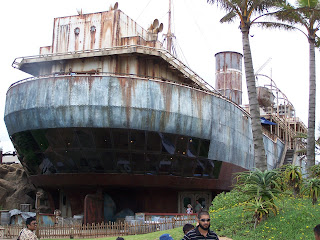 The sharks of Durban are legendary. There's a shark net set about 50 metres from shore or swimming and surfing would be impossible. The net gets checked every day but got completely washed away by the recent storms. Many of the creatures at Marine World (especially the sharks) are animals that are in captivity because got stuck in and injured by the net.
 Marine World is the fifth largest aquarium in the world. We simply ran out of time

 This is not to say that Lesotho is affluent. On the contrary, the money that Lesotho receives in payment from South Africa accounts for no less than one-quarter of the country's Gross National Product! As one would expect, most of the economy is comprised of subsistence farming. Still, it is known as a rather peaceful place and the
  Arriving in mid-morning through a minor border post in the north, our first stop was at a small school. It began not so many years ago through the efforts of an Catholic priest. Shortly after arriving he went to the parents in the community and suggested that a school be started. Most of them thought it was a dumb idea that would only divert their children's attention from what they really needed to know in order to survive. A few were interested, however, and agreed to send their kids when he offered to do the teaching for free. One farmer provided his sheep shed which was unused during the day. The kids who attended liked the experience so much that they soon began collecting stones for their own building. In time, a group of Irish volunteers arrived to build a proper facility. The community is now attempting to build a second structure based upon the model provide by the first.
 Nancy got to teach some of the older (adolescent) students- I've got some of her fine work on video. Those who teach will no doubt be interested to know that there was a copy of Bloom's Taxonomy on the wall! Barry Bennett doesn't seemed to have arrived yet. Following a snack, some socializing and a game of outdoor volleyball, our group set off to explore some of the nearby terrain, especially a beautiful cave complex above the village.
 The father-figure for the people of Lesotho is a man named
 Our tour include a stop at the local
  We had a very good day that ended with a laugh. Along the way through the village we encountered a very precocious little boy who looked to be no more than two. He raced to stay ahead of us and generally had a lot to say. Destined to be a great chief, no doubt. At the end of it all he
 Our visit began with a stop at Amphitheatre Backpackers, located in an ideal setting directly facing the Amphitheatre, a celebrated crescent of escarpment that stretches for five kilometres.
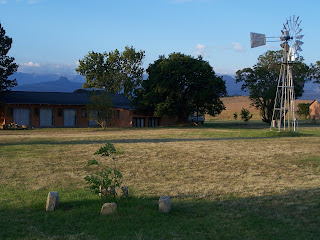 The pastures that lie at the foot of the mountains are a colourful mix of grasses and grains that help to frame the grandeur of the mountains. Here are a couple of views photographed from just in front of the hostel.
 Our goal was to get to the top of the Amphitheatre - a pretty daunting task given the altitude and distance that is involved. The hostel offers


 The most interesting part of our descent of the mountain was at a cliff requiring the use of chain ladders. There are two sections (25 metres and 16 metres). There's really nothing to fear but fear itself; however, the chain was pretty shaky and there were a few spots where the chain was too close to the rock to allow a foothold so we had to leapfrog a few rungs at a time. That made the legs start to wobble!


